 |
| Iglesias y cruces en Goa. Churches and crosses in Goa. |
 |
| Paseando con Ossa (Noruega). Having a stroll with Ossa (Norway). |
 |
| Ossa comprando coco. Ossa buying a coconut. |
 |
| También hay vacas. There are cows too. |
 |
| Cabeza de shiva, supuestamente esculpida por un turista. Shiva face, aparently sculpted by a tourist. |
 |
| Un coco al día te mantiene sano, dicen los locales. A coconut a day keeps the doctor away, locals say. |
 |
| Puesta de sol en Vagator. Sunset in Vagator. |
 |
"Hanuka samer!" Celebrando Hanuka con los israelitas.
"Hanuka samer!" Celebrating Hanuka with the israelies. |
 |
| Izq, yo, dcha Shahar. Me at left, Shahar at right. |
 |
| Puesto de observación en la pink house. Shahar, Marie y Lio. Observation post in the pink house. Shahar, Marie and Lio. |
 |
| Helado de mango con macedonia de frutas por 50 rupias (0'75€) con Kristoff, en Chapora. Mango ice-cream with fruit salad for 50 rupees (0'75€) with Kristoff, in Chapora. |
 |
| Yo, Roberto, Sid y un intruso haciendo cola para ver los restos de San Francisco Javier en su iglesia de Old Goa. Me, Roberto, Sid and an intruder queueing to see the rests of Saint Francesc Xavier in his church in Old Goa. |
 |
| Conversaciones de media noche en la pink house: Shahar, Marie y Roberto. Late night chats in the pink house: Shahar, Marie and Roberto. |
 |
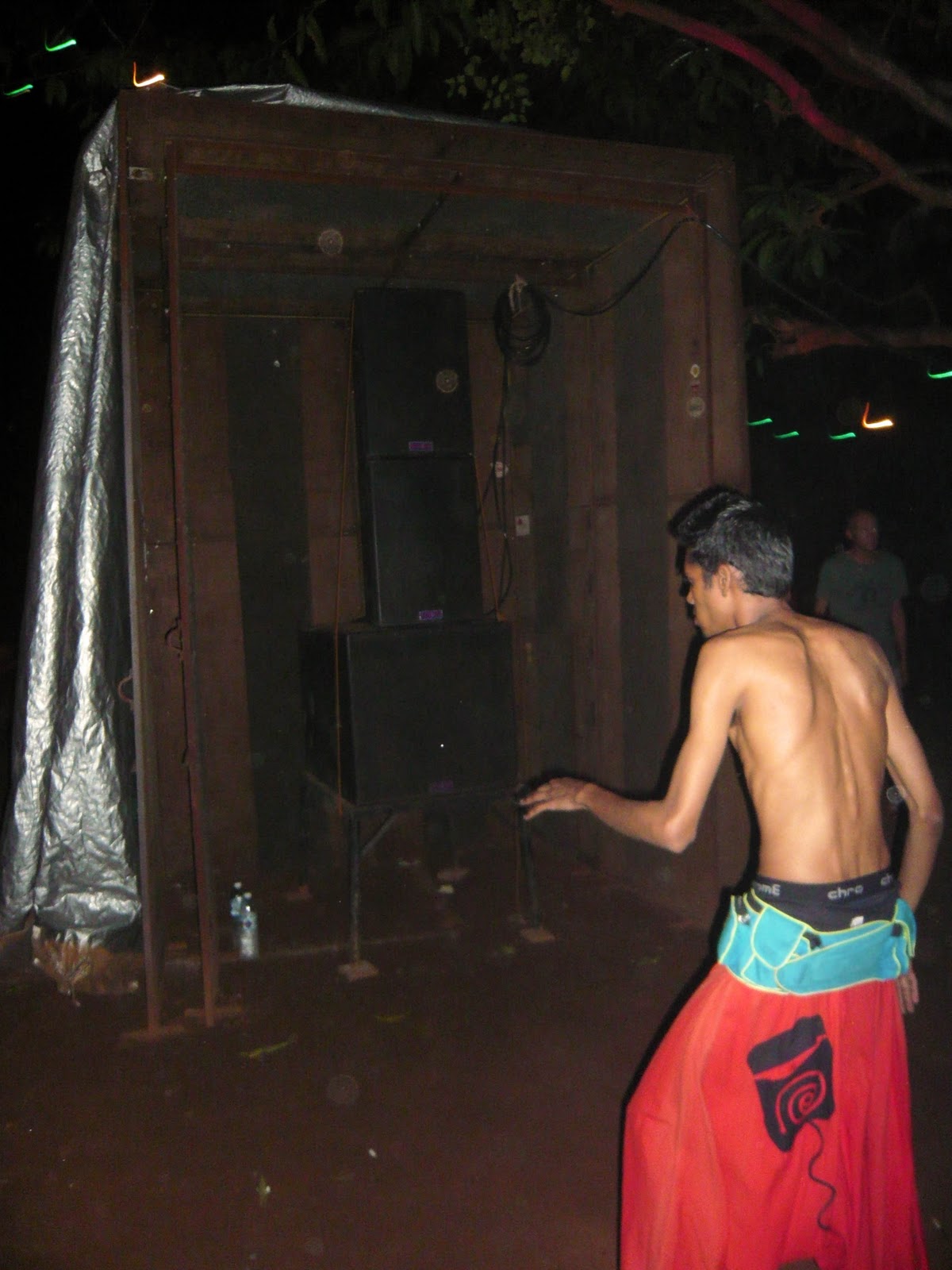
| Un loco come-bafles en una discoteca al aire libre (Hilltop). A crazy subwoofer eater in a open air club (Hilltop). |
Estado: Goa
En principio pensaba saltarme la casilla Goa. Goa tiene la reputación de ser un esstado alienado, llena de fiesteros de los años 60 -hippies- y de fiesteros contemporáneos -discotequeros trance-. No me hacía falta ir a otra Ibiza. Pero después de estar unos meses en la India, la de verdad, finalmente me decidí a cogerme unas vacaciones de mis vacaciones. Me quería quedar unos 4 días y al final me quedé 2 semanas.
Como en otros viajes nocturnos, la primera impresión al levantarse el sol o al abrir los ojos suele chocar. Esta vez fue al abrir los ojos, puesto que este autobús era de lujo (como uno normal en españa, con butacas individuales y asiento reclinable) y pude dormir. Todo verde. Palmeras a izquierda y derecha. La tierra casi roja. Algo increible: señales de tráfico y rayas pintadas en la carretera. Todavía más increible: no hay apenas basura en las calles.
Goa era una colonia portuguesa. Por ello, se encuentran muchos indios con nombre y/o apellido portugués y muchos cristianos. Cuenta la leyenda que si tienes mucha suerte puedes llegar a oir en Old Goa o Panaji una conversación entre gente mayor en portugués. La capital del estado de Goa, Panaji, no tiene playa y el turista sólo va de paso o hace un día de visita. Cada playa tiene su belleza y personalidad. Anjuna es la más conocida y la más hippie históricamente. Hoy en día el turismo es masivo y poco queda del espíritu de los 60. Después del movimiento hippie, llegaron los israelitas y sus fiestas rave. La tercera ola, que empezó hace unos años (no sé cuantos, digamos 10), se compone de engreidos turistas rusos que han elevado a Goa a un nuevo nivel de putrefacción. Recuerdo la primera vez que ví una rusa en Goa y la indignada conversación que mantuve con el vendedor que estaba a mi lado. La chica, en la parte trasera de una moto, llevaba un escueto bikini y pantalones poco más largos que la parte baja de su bañador. Choca bastante después de unos meses en India y luego no extraña a nadie que los turistas indios se queden mirando con descaro. Según entendí, Parlolem es una playa tan bonita como cara, con restaurantes y discotecas de lujo. Yo elegí Vagator beach, por estar marginada por el turismo. No era la playa más bonita pero seguro la más tranquila.
Una conversación que tuve meses más tarde en otro país:
“Wow, qué pesados son estos vendedores! Parece que estamos en Goa”, me decía un conocido.
“Yo en Goa estuve más tranquilo que en todo el resto de la India… estuve en Vagator beach, y tu?”
“Anjuna.”
Un detalle en Goa es que no hay impuestos sobre alcohol, lo que hace que una botella de ron Old Monk tenga el absurdo precio de 180 rupias (3€). No entiendo la razón, puesto que el resto de la India no invita a beber nunca alcohol y podrían sacar mucho de ello. Pero lo que no entra por un sitio entra por otro: prohibición total de fumar tabaco en sitios públicos (calles incluidas) y los policías van a multar. Por suerte la policía ignoraba Vagator tanto como los turistas.
Estuve en dos hostales. Al salir de la habitación del primero, el conocido como pink house o casa rosa, me encontraba con la playa. Fantástico, pero me moví porque el segundo era más barato. En este, la puerta daba a vegetación verde, un pequeño bosque. Y un día pude ver a mi vecino el pavo real que era demasiado tímido y se metió entre el follaje en cuanto me vió.
La comida de Goa agrega dos maravillosos ingredientes a la tradicional India: coco y pescado (o gambas, o sepia). El omnipresente thali indio evoluciona a fish thali, con pescado frito o guisado en vez de carne, y leche de coco en el curry.
Conocí en Vagator a Sahar y Lio, dos israelitas de viaje tras su servicio en el ejército y sin duda una de las razones por las que me quedé dos semanas allí. Hicimos grupo con Sid de India, Marie de Francia, Roberto de Italia y Kristof de Alemania. Vino a encontrarse con Shahar y Lio una chica israelita que casualmente había conocido antes en Kassol (Himachal Pradesh).
El primer día que hicimos escapada a una discoteca de una playa cercana (Anjuna), los camareros indios le dijeron a nuestro amigo indio Sid que no podía entrar… por ser indio. Después de una discusión nos volvimos todos a casa, una pena después de convencer a Roberto (de unos 50 años) de salir con nosotros.
Por cierto, el agua está templada incluso de noche. Genial.
State: Goa
At the beginning, I was going to skip Goa. Goa has a reputation of being an alienated state, full of party people from the 60s -hippies- and contemporary party people -trance clubbers-. I wasn't feeling like going to another Ibiza. But, after few months in India, I decided to take some holidays form my holidays. I was going for 4 days and I stayed for 2 weeks.
Just like other night trips, the first impression when you open your eyes or when the sun rises is s bit shocking. This time it was when I opened my eyes since the bus was a luxury one (like the regular ones in Spain, with individual reclining seats) so I could sleep. All is green, at left and right. The soil is almost red. Something amazing: there are traffic signs and painted lines on the road. Even more amazing: there's almost no garbage in the streets.
Goa was a portuguese colony. One can find a lot of indians with portuguese names or surnames and a lot of christians. The legens tells that if you're lucky enough, you might eavesdrop into a portuguese conversation between elder goans in Old Goa or Panaji. Panaji is the capital of the state, which has no beach and is just a passing point or one-day trip for tourists. Each beach has is own beauty and character. Anjuna is the most famous one and the historically hippy one. Nowdays turism is massive and there's little left form the 60s spirit. After the hippie movement came the israelis and their wild rave parties. The third wave, that started some years ago (no idea, let's say 10), is made out of bigheaded russian turists who brought Goa to a new level of putrefaction. I remember the first time I saw a russian in Goa and the offended conversation I had with the seller at my side. The girl, riding a bike, had a tiny bikini and shorts that were barely longer than the bottom part of the swimsuit. It's a bit shocking after few months in India and it's not surprising if indian turists stare at them shamelessly. as I understood, Parlolem is a beatiful as much as expensive beach, with luxury restaurants and clubs. I chose Vagator, for it was marginalized by tourism. It wasn't the most beautiful one but for sure one of the most quiet.
A conversation I had some months after, in another country:
"Wow, these sellers are really annoying! It's like Goa!", told me an adquaitance.
"When I was in Goa it was much calmer than in the rest of India... I was in Vagator, what about you?"
"Anjuna."
A thing about Goa is that there are no taxes on alcohol, and so a bottle of Old Monk rhum has the ridiculous price of 180 rupees (3€). I don't know why, since in the rest of India doesn't make you feel like drinking and they could have a good revenue. However, what doen't enter through one place enters fom another: it's illegal to smoke tobacco in public places (streets included) and the cops focus on those fines. Luckyly the police ignored Vagator as much as the tourists.
I've been in 2 hostels. When I come out of my room in the first one, known as Pink House, I had the sea just in front of me. I went to a second, more economical one. In this one, the room was in front of a lot of green vegetation, a little forest. One day I could see my neightbour, the peacock, who was too shy and ran away though the bushed when he saw me.
Food in goa adds to wonderful ingredients to the traditional indian one: coconut and fish (or shrimp, or squid). The omnipresent thali evolves into fish thali, with fried or stewed fish and coconut milk in the curry.
I met there sahar and Lio, two israelis travellign after their army service, and without any doubt one of the reasons I stayed there for 2 weeks. We joined others in a group: Sid from India, Marie from France, Roberto from Italy and Kristof form Germany. An israely girl friend of Shahar and Lio came to meet them and it happened that I knew her fomr Kassol (Himachal Pradesh).
The fisr day we went for a club in another beach (Anjuna), the indian waiters told out indian friend, Sid, that he couldn't enter because... he was indian. After an small argument we went back home, a shame cause we had convinced Roberto (around 50 yo) to come with us.
By the way, water is warm even at night. Great.




 Entradas



