Mostrando entradas con la etiqueta monumentos / monuments. Mostrar todas las entradas
Ajanta: las cuevas. The caves. [19.11.2010]
Aquí va un gran lote de fotos.
Here goes a big load of pics.


Panorámica desde la última cueva. Panoramic view frmo the last cave.

La pintura más famosa, en la cueva 1. The most fmous painting, in cave no 1.

Buddha en posición de predicación. Buddha in preaching stance.

Otro Buddha en la misma posición. Another Buddha in the same stace.

Columnas de una cueva. Columns in a cave.

Buddha, Buddha, Buddha...

La fachada más impresionante de las cuevas. The most impressind façade of the caves.

Más pinturas. Las puertas son pequeñas celdas para los monjes. More paintings. The doors are small cells for the monks.

En gris, roca tallada. En blanco, la primera capa con pinturas hecha al principio. En oscuro, la segunda capa con pinturas, hecha 5 siglos después. In grey, carved rock. In white, the first couch of paintings, donde at the beginning. In dark, the second couch of paintings done 5 centuries later. 

Grabado. La mano es para ver su tamaño. Engraving. The hand is for seeing its size. 

En construcción: pared tallada con la figura de Buddha a medio hacer. Under construction: carved wall with the shape of Buddha.

Turistas en una cueva con stupa. Tourists in a cave with stupa.

Vista de las cuevas. View of the caves.

¿Quién es este señor? ¿Who is this man?

Tareas de conservación. No lo creo, andamio de metal con motor en vez de madera, monos de trabajo... ah, que son coreanos. Conservation tasks. I cannot believe it: overalls, scaffolding with engine instead of wood... oh, ok, they are korean.

Detalle de columna.

El Buddha. Detrás, un impostor. The Buddha. Behind, an impostor.


Estado: Maharashtra

Ajanta no tiene estación de tren, así que paré en una pequeña ciudad llamada Aurengabad. Fui al sitio más barato que aparecía en la guía: YHA hostel. 150 rupias por noche en un dormitorio. La mujer que lo llevaba tenía tanto de encantadora como de esquizoide. Tenía en su libro de cuentas una gran imagen de un Jesucristo bastante maltrecho y a su lado, una pegatina de Shiva (una muestra del cacao religioso que a veces tienen en la India). Las reglas de su hostal estaban diseñadas para atacar los nervios del huésped. Las puertas cierran a las 21h y si llegas 15 minutos tarde la señora o el guardian de noche te miran con mala cara. A las 22/23, hay que apagar las luces del dormitorio o vendrá el guardián a recordártelo. Hay que pagar 10 rupias por día por aparato electrónico que enchufes a la corriente. Si quieres dejar la mochila en el hostal el día que te marchas, porque tu bus/tren sale por la tarde, tienes que pagar 20 rupias. Y alguien, supongo que el guardían de noche, me robó la manta de Aeroflot que robé con cariño del vuelo Moscú-Delhi.

Las cuevas de Ajanta son un conjunto de 29 cuevas talladas en roca donde moraba una comunidad de monjes budistas. Se encuentran en un pequeño valle, formando una media luna que rodea un río en su parte más baja. Las primeras fueron construidas en el Siglo II AC y las últimas en el Siglo VI DC. Han sido declaradas patrimonio de la humanidad por la UNESCO en 1983. Fueron patrocinadas en su día por reyes (rajas) y personas poderosas. En el Siglo VI, con el budismo decayendo en India, por razones desconocidas las cuevas fueron abandonadas. Algunas de ellas todavía estaban en proceso de construcción. Las redescubrió un oficial inglés en 1819.
Como siempre, es una pena ir sin guía, pero no me fío ni un pelo. Un guía indio estaba buscando cliente y al verme quiso darme una muestra de su conocimiento, para que le contratara. Señaló del dedo unos grabados dónde se podían ver una figura con cara atormentada y otras dos, juntas, sonrientes.

- Mira… esto significa que el hombre no puede estar sólo. Sino, está triste. Cuando encuentra a su pareja, se completa y es feliz.
- ¿Cómo? Pero… ¿me puede explicar por qué unos monjes budistas querrían mandar ese mensaje?
Empezó a reir y se fue. Quizás tuviera razón, pero me sigo sin fiar.

El bus tardó en venir más de la cuenta y al volver al hostal tuve que suplicar otra vez que me abrieran  la puerta.


State: Maharashtra

Ajanta doesn't have a train station, so I stopped in a small city called Aurengabad. I went to the cheapest place according to the guide: YHA hostel. 150 rupees per night in a dorm. The woman managing it was as charming as psycho. She had in her accounting book a big image of a battered Jesuschrist and, at his side, a sticker of Shiva (an example of the religious confusion you have in India). The rules of the guesthouse are specifically designed to annoy the guest. The door closes at 21h, should you arrive even 15 minutes later, the woman or the night guardian pull faces to you. At 22/23h, the lights of the dorm have to be turned off, otherwise the night guardian will come to remind it to you. You have to pay 10 rupees per day for each electronic device you charge. If you want to leave your backpack the day you leave, because maybe your train/bus is going in the evening, you have to pay 20 rupees. And someone, I guess the night guardian, stole from me the Aeroflot blanket that I stole with love from the flight Moscow-Delhi.

Ajanta caves are a bundle of 29 rock-cut caves used as a dwelling by a community of budist monks. The are located in a small valley, in a shape of a halfmoon surrounding a river on the bottom part. The first ones were built on the II century BC and the last ones on the VI century AD. They've been declared World Heritage Site by UNESCO in 1983. They were patronized by kings (rajas) and rich people. In the VI century, with budism decaying in India, for unknown reasons the caves were abandoned. Some of them were still under construction. They were rediscovered by a british officer in 1819.
It's a shame to go without a guide, but I don't trust them at all. An indian guide looking for customers gave me a sample of his services. He pointed out engraved figures where you could see some person in a tormented state, and at his side, two smiling persons together.

- Look, this means that a man cannot be alone. If he does, he's sad. When he finds a wife, he's happy.
- How? Why would budist monks give this message?
He laughted and left. Maybe he was right, but I still don't trust them.

The bus came late and when I was back in the city I had to beg again so they would open the door.
Karni Mata: Templo de las ratas. Temple of rats. [09.11.2010]
Siesta.

Leche. Milk.

Ratas sin miedo al hombre. Rats with no fear of humans.

Altar.

Y más ratas. And more rats.


Estado: Rajastan

Desde Bikaner cojimos un bus que nos llevó a Deshnoke para visitar Karni Mata, el templo de las ratas de 600 años de antigüedad. Preferí no saber de lo que se trataba pero a alguien se le escapó. Por otra parte era lo obvio: ratas. Muchas ratas, siendo la cifra oficial más de 20 000. Al ser un templo hay que entrar sin calzado, pero este templo está impregnado del olor a rata bastante soportable. Salen y entran ratas por cualquier agujero del templo. Los devotos les traen unos dulces redondos amarillos que no eran nada del otro mundo. Las ratas se cuelan entre tus piernas. En el altar, donde se encuentra el dios o dioses a los que va dedicado el templo, hay un gran cesto de comida que a veces comparten ratas y pandits (sacerdotes) o devotos. Las ratitas no son feas, son más ratones que ratas. Y dan un poco de pena porque muchas tienen la cola rota (torcida) como en los dibujos animados. A la salida hay una fuente para poder lavarse los pies.
Nadie de nosotros vió ninguna rata blanca, así que nos quedamos sin la buena suerte que esta debería dar.


State: Rajastan

We took a bus from Bikaner to Deshnoke to visit Karni Mata, the 600 years old temple of rats. I didn't want to know anything about it beforehand but someone said it. On the other hand, it was obvious: rats. A lot of rats. Since it's a temple one has to enter without shoes, but this temple is filled with the smell of the rats without being unbearable. Rats go in and out every hole of the temple. Devotees bring round yellow sweets whch are not that good, but still ok. Rats run between your feet. At the altar, where are located the figures of the god or gods for which the temple was built, there's a big basket with food offerings for sharing sometimes between rats and pandits (priests) or devotees. The rats are not ugly, ressembling more to mice. And sometimes it's sad because their tails are broken (bent) like in the cartoons. At the exit there's a fountain so you can wash your feet.
None of us spoted any white rat, so we were deprived of the good luck that this should bring.

Amritsar: Harmandir Sahib [02.11.2010-05.11.2010]
Habitación para extrangeros en las instalaciones del templo. Foreigner's room within the facilities of the temple.

Humor: un guardia del templo increpando a un sikh anciano por quitarse el turbante. Humour: a guard from the temple rebuking and elder sikh for removing his turban.

Dos guardias del templo. Two guards from the temple.

Preparándose para darse un baño en la piscina sagrada. Ready for a bath in the holy pool.

Comedor. Cada turno de comida es de aproximadamente 10 minutos. Canteen. Every shift is around 10 minutes.

La cocina. The kitchen.

Trabajo infantil: un joven se ha quedado dormido mientras pelaba patatas en un restaurante cerca del templo. Child work: a youngster got asleep while peeling potatoes in a restaurant close to the temple.

Las instalaciones no pueden albergar a todos los peregrinos. El patio se llena por completo de gente durmiendo. The facilities cannot accomodate all the pilgrims. The courtyard gets full of people sleeping.

Templo Mata Di. Mata di temple.

Kali, mi diosa favorita, en el templo Mata Di. Kali, mi favourite goddess, in Mata Di temple.

Templo Mata Di: cavernas y riachuelos. Mata Di temple: caverns and streams of water.


Estado: Punjab

Cogí un bus de Kassol a Amritsar, la ciudad más importante (auque no capital) del Punjab. En el trayecto conocí a Adam el barbudo con el que pasaría los días en Amritsar.
Punjab es un estado del norte de la India. Es la cuna del Sikhismo y la cantidad de gente que sigue esta religión es muchísimo mayor que en cualquier otra parte. Los Punjabis suelen ser tener bastante tendencia a emigrar a otras partes del mundo. Su constitución es más fuerte que la de los demás indios, ganándoles en altura y en barriga. También suelen ser buenas personas y son considerados por los demás indios como gente simple (tontos). Son por lo tanto la fuente de muchos chistes (como los de Lepe para los españoles, los belgas para los franceses…).
En Amritsar se encuentra el templo dorado (Harmandir Sahib): la razón por la que la gente visita la ciudad. En el templo dorado, se aloja y da de comer a los peregrinos de forma gratuita. Han habilitado además unas habitaciones para alojar a turistas por un máximo de 3 días. Según me contaron, el guru que hizo construir el templo dijo algo así: “he estado toda mi vida comiendo de lo de los demás (era un poco vago y muy gorrón), así que haced el favor de levantar un templo donde se dé de comer gratis”. El templo da de comer hasta 100 000 personas al día, con turnos de comidas sin descanso, hasta tienen una máquina de hacer rotis (o chapatis, parecido al naan…. o sea: pan). Por supuesto aceptan donaciones y ayuda. Así que ayudé durante unas 3 horas pelando cebollas. La gente de allí era agradable, aunque nunca te puedes quitar el traje de blanco rico. Una chica joven empezó a contarme sus vida. Después de media hora de hablar y quejarse, me pide una ayuda. Luego me dice que no tiene dinero para el alquiler de la casa, que si se lo puedo pagar. Seguramente puedo comprarte la casa y un coche y todo lo que quieras, ¿no ves que soy blanco? Al final me fui cansado de sus peticiones. Me la encontré afuera con cara de perro abatido y hambriento. Está bien, toma 300 rupias. Me mira a la cara y me dice “¿ya está? ¿sólo esto?”. 300 rupias son 5 euros (y puede ser el salario diario de alguien). Me enfadé, le contesté que tenía que haber dicho “muchas gracias” en vez de eso y me fui con la seguridad de no volver a dar más dinero a nadie. O por lo menos durante unas semanas.
Conocimos a dos pequeños sikhs simpáticos. Los jóvenes son los que llamo “los de la patata”. No suele llevar turbante sino una bandana con un moño en la frente: la patata. Nos acompañaron un rato y me sorprendí cuando pude hablar con el más pequeño de unos 7, que sabía tres palabras de inglés. Mi nivel de hindi también es muy básico pero lo curioso es que tras un rato entendí que él estaba hablando en Punjabi y nos podíamos entender. Me costó 10 minutos entender que quería matar a todos los ingleses porque ellos mataron a su abuelo en una revuelta que hubo en Amritsar. La mayoría de los jóvenes occidentales han oido punjabi a través de esta canción : Mundian to Bach Ke.
En esta ciudad se encuentra el templo de Mata Di. No sé quién es Mata (Madre) Di, salvo por unas fotos antiguas de una anciana con gafas. Los templos hindúes, sobre todo los nuevos, cansan mucho. Una vez has visto 3 ya has visto todos. Son una inaceptable mezcla entre lo sacro y lo kitch, entre lo arcano y el plástico barato. Pero este salía de lo normal. Para hacer el tour de las imágenes, de las estatuas a las que rendir honores, hay todo un recorrido por escaleras , por agujeros en los que hay que entrar a 4 patas,  una caverna de cartón-piedra con un palmo de agua en el fondo, subir, bajar, espejos, brillantes, luces…
Tras estos días venía Diwali y quería celebrarlo en Delhi con Tarun. En la habitación para extrangeros del templo dorado conocí a Aimee (Amy, Inglaterra) que justo tenía el mismo tren que yo. Ambos fuimos a Delhi.


State: Punjab


I took a bus from Kassol to Amritsar, the most important city (but not the capital) of Punjab. During the journey I met Adam the bearded, with who I would spend my days in Amritsar.
Punjab is a state in the north of India. It's the craddle of Sikhism and those who follow this religion are much more present here than in any other part of the country. Punjabis tend to emigrate to other parts of the world. Their physical build is stronger than the rest of indians, beating them in highness and bellyness. They are usually nice people and are thought of by the rest of indians as simple (stupid) people. Therefore they are the source of many jokes.
The golden temple (Harmandir Sahib) is in Amritsar: the reason why people visit the city. In the golden temple, free accomodation and food is given for pilgrims. They opened some rooms specially for tourists for a maximum of 3 days. I was told that the guru who made this temple to be contructed said something like this: "I´ve been eating all my life from the others (he was a bit lazy and a big freeloader), so please build up a temple where people can eat for free too". The temple feeds up to 100 000 persons a day, with non stop lunch turns. They also have a roti (or chapati, similar to naan... i.e. bread) making machine, something amazing in India. Obviously they accept donations and help. and so I helped for around 3 hours peeling onions. People were nice there, but you can never take out your rich white man suit. A young woman was telling me her life. after half an hour of speaking and complaining, she asks me for help. Then she tells me that she dooesn't have enough money for the rent and asks me if I can pay it. Of course I can pay it, and if you want a car I can pay it too, can't you see that I´m white? I left tired of her begging. I ran into her outside, with her fgace like a sad and hungry dog. It´s ok, take these 300 rupees. She looks up and says "only this?". 300 rupees are 5 euros (and can be the salary of a day here). I got upset, I told her that she should have said "thank you" instead of that and I left knowing that I would not give any more money to people. Or at least for few weeks.
We met two nice young sikhs. The young ones are the ones I call "the potato ones". They don´t wear turban but instead a bandana with a bun: the potato. They cmae along for a while and I was suprised to see that I could communicate with the younger one, around 7, who knew few words of english. Mi hindi level is very basic but after a while I realised he was actually talking in Punjab and we could understand each other. It took me 10 minutes to understand that he wanted to kill all englishmen because they killed his grandfather in a riot in Amritsar. Most of the Yong western people has heard punjabi through this song: Mundian to bach ke.
In this city you can find the Mata Di temple. I don´t know who she was, besides some anciet pictures of an elder woman with glasses. Hindu temples, and more if they are new, are a bit annoying. Once you´ve seen 3 of them it´s like you´ve seen all of them. They are an unacceptable blend between the sacred and the kitsch, between the arcane and the cheap plastic. But this one was special. For seeing the images, statues for worship, there's a big path through stairs, holes where you can only enter crawling, a cavern made out of papier-mâché with several inches of water at the bottom, go up, go down, mirrors, glitters, lights...
Diwali was coming and I wanted to celebrate it with Tarun in Delhi. In the same room in the golden temple I met Aimee (Amy, UK) that had a ticket in the same train as me. We both went to Delhi.

Agra
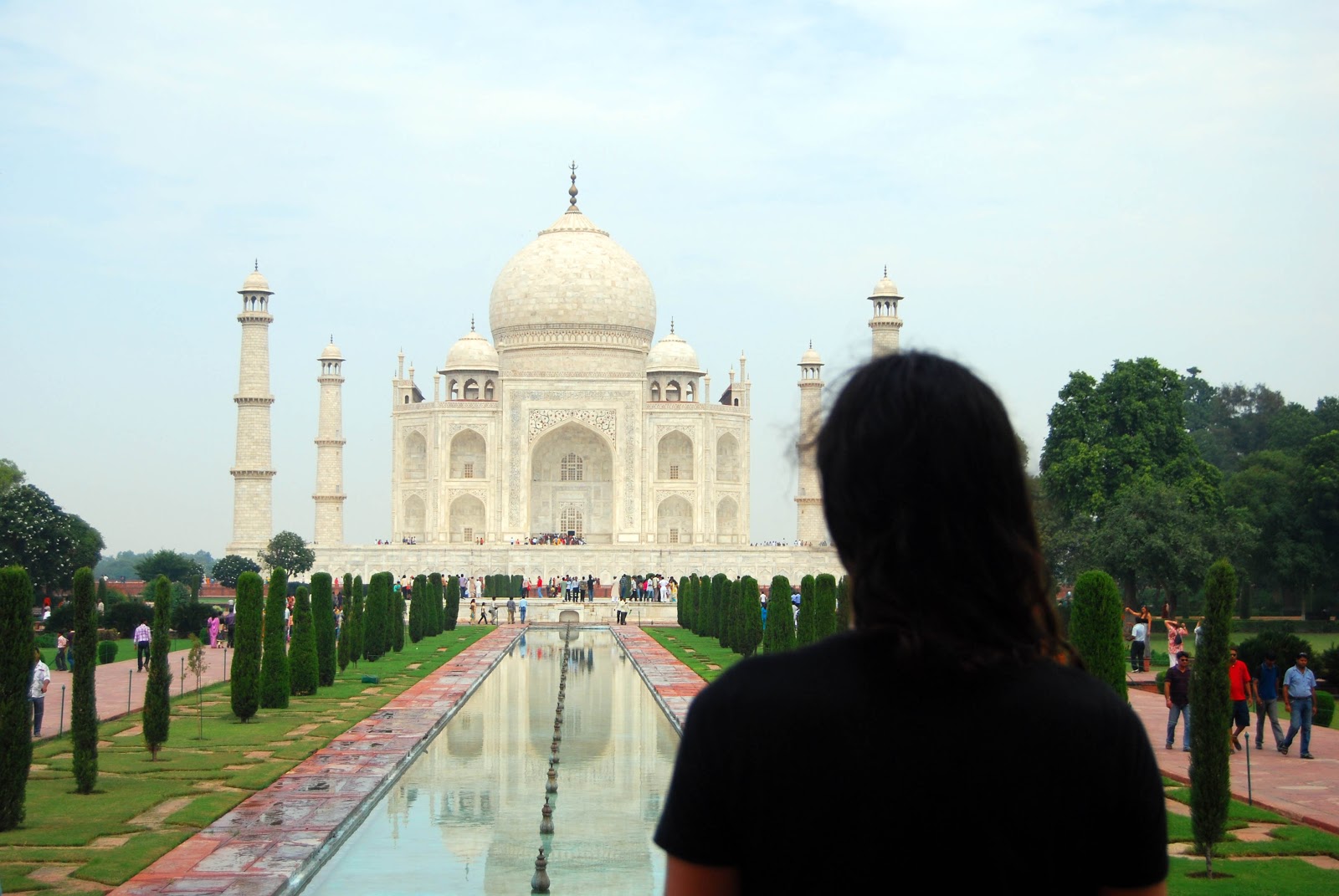
Wow... es... como... en las fotos. Wow... it´s... like... in the pics.

Sikh haciendo turismo. Sikh doing some tourism.

¿Dónde están mis rupias? Where are my rupees?


tomada desde la mezquita a la derecha del Taj. Taken form the mosque at the right of the Taj.
 
Fuerte de  Agra. Agra Fort.


4 Octubre 2010. No puedes ir a la India sin visitar el Taj Mahal. Más que nada por evitar dar explicaciones en un futuro, puesto que es la pregunta que todo el mundo hará. Me da un poco igual el Taj Mahal. Porque lo he visto mil veces. Porque está quemado. Así que un poco a regañadientes, me pongo los calcetines blancos con sandalias (merecería ser ejecutado si esto no fuera una metáfora) y me dirijo a Agra. Sorpresa, Agra es la madre de todos los timos. Se me presenta un conductor de rickshaws. Me enseña la cabina de prepago (normalmente una forma de evitar que el taxista te time) oficial para ir al Taj, su identificación oficial y la lista de precios oficiales en papel plastificado. Me quiere hacer creer que los indios pagan 400 rupias (6,6€) por ir al Taj, ir al Agra Fort (el fuerte) y volver a la estación. Le digo que no. Me hace descuento (300) por trabajar en una ONG y ayudar a su país. Estos son los más cabrones (con perdón): otro engaño para que caigas en la trampa. Al final tras discutir un rato me lleva por 50 rupias, auque más tarde me enteraría de que sigue siendo caro. Compro tabaco: la mujer me  devuelve mal el cambio dos veces y tengo que levantar la voz para que me lo dé bien porque se hace la tonta. A la vuelta cojo un cicle rickshaw (20 rupias) pedaleado por un hombre de unos 50 años. También me intentó engañar con el cambio y me llevó a una tienda de cámaras de fotos para que comprara una.
Pero el mayor de todos los engaños es que la entrada al Taj Mahal vale 750 rupias (12,5€) si eres extranjero y 20 (0,30€) si eres indio. El fuerte 300 rupias (5€) y otros 20 si eres indio. Y no, no funciona decirles que eres indio en hindi, sólo se ríen un poco de tí.
El Taj Mahal en sí no es ninguna sorpresa. No me enteré demasiado de lo que veía porque no cogí ningún guía (hasta las narices de guías, comisionistas e indios en busca de dinero), leí sobre ello a la vuelta. Al primer vistazo al Taj Mahal algo se mueve dentro. Es como volver a un sitio en el que estuviste en tu infancia, algo familiar y remoto a la vez. Tras la primera impresión, todo ordinario. Muy bonito, si, pero sigo pensando en mis rupias. El mausoleo no se puede fotografiar; es bonito pero tampoco para morirse.
El fuerte también es bonito, construido en ladrillo rojo y luego capturado por los mogoles. Habiendo en su día construcciones de madera y mobiliarios, no te haces a la idea de cómo podía ser. “Aquí había una sala de reuniones que lo flipas llena de oro y movidas”: una sala grande y vacía. “Aquí había un palacete de madera superchulo donde  el Raja se retiraba a meditar”: un gran vacío.
Entre los dos sitios me hice, sin exagerar, unas 10 fotos con indios. Unos me decían que parecía un músico (iba de negro con gafas de sol), otros que parecía muy “smart”, un hombre me pone a sus hijas a cada lado y no hace la foto hasta que no paso los brazos por los hombros de ambas a petición suya , otro me pidió que me volviera a poner las gafas de sol para la foto...


Para quellos aburridos, bajaros compraros la pelicula The Fall (El sueño de Alexandria) de Tarsem Singh. Tiene escenas rodadas en el fuerte de Agra, en Jaipur, en Jodhpur...

4th October 2010. You cannot go to India without visiting Taj Mahal. Mainly to avoid having to explain things, since it's the question that people will more likely be asking. I don't care that much about Taj Mahal. Because I've seen it tousands of times. Because it's burned out. Then, a bit reluctantly, I put my tourist cap and sunglases, take my camera and lead to Agra. Surprise: Agra is the biggest scam center on earth. A rickshaw driver comes to me. He shows me the official prepay booth (which is usually a good way to avoid taxis riping you off) for the Taj, his official driver identification card and the official prices list on a plastified paper. He's trying to make me believe that indians pay 400 rupees (6,6€) for going to Taj Mahal, then Agra Fort, then back to the station. I say no. He then makes a discount (300) because I'm working in an NGO and I'm helping his country. These ones are the most bastards (sorry): again he wants to fool me. After arguing for a while he takes me for 50 rupees, however I would know later that it's still expensive. I buy tobacco: hte woman gives me the wrong change twice and I have to raise my voice to have my money because she's pretending to not understand. When coming back I take a cicle riskshaw (20 rupees) driven by a 50 years old man. He tries to fool me with the change and brought me to a shop to buy a photo camera.
But the biggest scam is the entry fee for the Taj Mahal which costs 750 rupees (12,5€) for foreigners and 20 (0,30€) if you are indian, while Agra Fort is 300 rupees (5€) for foreigners and 20 again for indians. And no, saying that you're indian doens't work, they just laugh.
The Taj Mahal is not any surprise. I didn't know exacly all that I was seeing (shame) because I didn't take any guide (I'm fed up with guides, comissionists and indians looking for money), I read about it when coming back. The first glance to Taj Mahal makes something move inside you. It's like coming back to a place you went when you were kid, something familiar and remote at the same time. After the first impression, all is ordinary. Very beautiful, yeah, but I'm still thinking about my rupees. The mausoleum cannot be photographied. It's beautiful but not to die for.
The fort is beautiful too, built in red bricks and captured by the mogol empire. In his glory days it had wood constructions and furnitures, so you cannot figure out how it could be. "Here was an awesome meeting room full of gold and stuff": a big empty room. "Here was a small and groovy wood palace where the Raja was going for meditation": a big empty space.
During the visits I had around 10 pictures with indians. Some said that I looked like a musician (black clothes and sunglases), others that I looked smart, even a man put each of his two daughters at my sides and didn't take the picture until I didn't pass my arms around their shoulder at his request, a guy asked me to put back my sunglases for the picture...

For those who are bored, download purchase the movie The Fall by Tarsen Singh. It has scenes filmed in Agra Fort, Jaipur, Jodhpur...
Turismo en Delhi. Tourism in Delhi.
Delhi, por muy saturada de ruidos, tráfico, malos olores y peor gente tiene algunos atractivos turísticos. Para los que les haga gracia ver las mismas fotos (de vacaciones o revistas) de siempre. Por razones tecnicas, este post se salta las tildes cuando le da la gana.

Delhi, even saturated with noise, traffic, bad smell and worse people has some turistic appeal. This is for those who enjoy the same holiday/magazine pictures once and again.


Humayun’s Tomb


No hay gran cosa que recalcar, es una tumba del siglo XVI del imperio mogol. Primera sorpresa con los precios turistas: 250 rupias (4,16€) para mi, 10 rupias (0,16€) para un indio, 2000 (33,33€) para alguien de Pakistán. Lo último es conya.


Nothing very special to say, it’s a tomb from the XVIth century from the mogol empire. It was the first surprise with tourist prices: 250 rupees (4,16€) for me, 10 rupees (0,16€) for an indian, 2000 (33,33€) for a Pakistani. Last one is for kidding.


Un indio cualquiera en Humayun's tomb, lloviendo. A random indian at Humasyun's tomb while raining.


Jama Masjid


La mezquita más grande de Asia.  Aún siendo un lugar de culto, te piden entrada. Yo la pagué -200 rupias o 3,3€- , sin saber que es ilegal pedirla (ahora ya leo la Lonely). Y otras 100 para subir a la torre, esta vez legalmente aunque los indios paguen 10. La torre merece la pena, es alta y marea, aunque ni allí te libras del omnipresente ruido del tráfico. Durante mi estancia en Delhi hubo un intento de atentado en la puerta en el que ardió un coche (bomba fallida) mientras dos personas en una moto tiraban contra un autobús de turistas. Hubo dos koreanos heridos graves y fue reinvidicado por IM (Mujaidines de India).

The Digest mosque in Asia. Even being a worship place, an entry has to be paid. I paid it -200 rupees or 3,3€-, unknowing that it’s not legal and you can enter witt out it (yeah, now I read Lonely). Plus 100 for gong up the tower, this one legally though indians pay 10. The tower is worthwhile, it’s high and makes you (me) feel dizzy, however even up there you cannot escape from the omnipresente traffic noise. During my stay in Delhi there was an attack at the gates in which a car started to burn (bomb didn‘t work) while two persons in a bike started to shoot at a tourist bus. Two koreans were badly injured  and the responsability was claimed by IM (Indian Muhaidins).

Un indio en Jama Masjid, primer piso. An indian in Jama Masjid, first floor.


Minarete. Minaret.


Una mujer musulmana mira impotente como alguien le roba el alma con una maquina infernal. A helpless muslim woman  looks how someone steals her soul with a evil device.


Otro haciendo gargaras en la piscina comun. A guy gargling in the common pool.


Gurudwara Bangla Sahib

Una gurudwara es un templo Sikh. Sikhismo es la tercera religión del país, es la comunidad india que más emigra (seguro que tienes un Sikh cerca de tu casa) y, entre otras cosas, su religión obliga a tener turbante y barba. Pese a ser una religión de voluntad de convergencia (y a la vez de reacción al Islam y al Hinduismo), sorprende que a la vez tenga nuevas y estrictas reglas y milagritos de sus gurús. La que te afecta como turista es la de llevar la cabeza tapada, ir descalzo (igual que en Hinduismo e Islamismo) y lavarse los pies a la entrada, no llevar alcohol ni tabaco en los bolsillos y no dar la espalda a su libro sagrado (con lo que nos ganamos algunas miradas y comentarios ofendidos).

Son los mejores templos, con alguien que lee melodicamente sus textos sagrados te puedes sentar y relajar durante un buen rato. Se parece un poco al raggamuffin/dancehall. Menos cuando te hacen levantarte durante un rato que te cortan todo el relax.

A gurudwara is a Sikh temple. Sikhism is the third biggest religion in the country and it’s the indian comunita with more expats (there‘s likely a Sikh close to your place) and, amongst other rules, it’s mandatory for them to wear a turban and beard. Being a religion with a convergence will (and at the same time being a reaction against Islam and Hinduism), it’s surprising they have new and strict rules and miracles from their gurus. The one that affects you as tourist is to cover your head, be barefoot (just like Hinduism and Islam) and wash your feet before entering, don’t have any tobacco or alcohol and don’t turn your back against their holy book (we had some stares and offended comments wih that).

It's the best kind of temple, with someone reading and chanting the holy scriptures, you can sit down and relax for a while. It's similar to raggamuffin/dancehall. But when they make you stand up they stop all the chill out.

Dos sikhs con el traje tradicional. Two sikhs with traditional clothes.

Lavadero de pies. Aqui no hacen gargaras. Foot cleaning, here they dont make gargles.
Entrada principal. Main entry.

Helen & Varun. Despues de la primera bronca por dar la espalda. Cuando no mires me dare la vuelta. After the first row because of turning our back. When you won't be looking I will turn around again. 


En el medio leen el Guru Granth Sahib. In the middle, Guru Granth Sahib is read.


Qutab Minar


Es el minarete (torre de mezquita) más alto del mundo. Hay ruinas esparcidas a los pies de la torre. Como muchas veces pasa, la poca información -si no vas con guía (que tienes que pagar y a veces resulta un fraude)- dificulta el recrearnos mentalmente cómo fue el sitio en su época floreciente. También es destacable un pilar de hierro en el centro de la plaza. Al parecer algunas guías lo clasifican de OOPART. Al estar a punto de cerrar las puertas de mis 250 rupias, le pregunto al guardia de seguridad rodeado por policías por el curioso pilar que parecía fuera de contexto. “Pilar mágico, tu tocas y mucha suerte… quieres tocar?” A mi respuesta afirmativa le seguió una mano adelante acompa?ada de la palabra propina y la sonrisa de los policías. Que no. Mientras me marcho con Hellen, me vuelve a asaltar por detrás “mucha suerte para ti, para novia, para familia”. Mientras, detrás de él se desarrollaba una escena circense en la cuál los policías se turnaban para abrazar y frotarse contra el pilar. Justo entonces fue pisé un charco de barro mientras el guardia insistía. Mala suerte.

It‘s the highest minar (tower in a mosque) in the world. There are ruins spread around the base of the tower. Like most of the times, the scarce information -if you didn’t take a guide (who has to be paid and sometimos is a fraud)- make difficult to recreate mentáis how was the site at its flourishing era. It is an outstanding iron pilar in the center of the square. Aparently soime guides clasify it as OOPART. Minutes before the closing of my 250 rupees, I ask the security guard surrounded by policemen about the curious pilar which looked out of context. “Magic pilar, you touch and gives good luck. Want to touch?” My afirmative answer was followed by a hand forward and the word “tip“ and smile from the police. No way. While gong out with Hellen, he comes from venid “good luck for you, for family, for girlfriend”. At the same time venid him, a circus show was being performed by the policemen who were hugging and rubbing themselves to the pilar in turns. Then, with the security guard insisting, I stepped into a mud puddle. Bad luck.

A los pies del minarete, con Hellen. At the minaret's feet with Hellen.

Dos asesinos ninja en la noche. Two ninja assasins in the night.
Pilar de metal para refrotarse. Metal pilar for rubbing yourself with.


Akshardham

Los templos hindús no suelen ser especialmente elaborados. Tienen gracia, colores, incienso, pétalos de flores, mendigos y ventiladores. Muchas veces se limitan a una sala que por tama?o y por sus baldosas parece a un cuarto de ba?o con una imagen del dios del templo en el centro. Ashkerdam es el primero templo que me ha sorprendido e impactado de verdad. La cantidad de trabajo humano usado para levantarlo es increíble. No me podía creer que todo estuviese grabado en piedra y no se usaran moldes. Y no los usaron. El altar principal puede llegar a marear un poco de la cantidad de detalles y la cantidad de oro usado. Tiene además tres shows de pago, el cual destaca el espectáculo de luz y sonido de la fuente (mejor que la fuente mágica en Barcelona) por 30 rupias (0,50€). El templo en sí es gratuito, pero como normas especiales destaca la prohibición de entrar bolsos, cámaras, tabaco, mecheros, alcohol o cuero.
La foto no es mia, la he robado de http://www.travelindiapictures.net

Indian temples are not especiáis elaborated. They are curious, they have colours, incense, flower petals, beggers y fans. Many times these temples, because of their size and the tiles, look like a bathroom with a statue of the god. Ashkerdam is the first temple that rally surprised me. The amount of human work to build it up is overwhelming. I couldn’t relieve that everything was engraved in stone witt out the help of moulds. The main altar can even make you dizzy because of all the details and the gold. It has 3 paying shows, sparring a music and light fountain show (better than the magic fountain in Barcelona) for 30 rupees (0,50€). Access to the temple is free of charge but there are some rules like no bags, cameras, tobbacco, lighters, alcohol or leather.
The picture is not mine, I stole it from http://www.travelindiapictures.net


Lotus Temple


El templo del loto, para el que no lo conozca, es uno de los 7 templos Bahai del mundo. Esta nueva religión es un intento de convergencia entre todas las anteriores. En su interior sólo hay sillas para rezar o meditar y un discreto altar sin simbología. La idea es que sirva de lugar de culto para gente de cualquier religión. No tengo fotos tampoco, llovía demasiado aquél día. Y sí, la Casa de la Ópera de Sydney es igual.
Otra foto robada de http://www.travelindiapictures.net

Lotus temple, for those who don’t know it, is one of the 7 Bahai temples in the world. This new religion is an atempt of convergence of all previous religions. Inside there is only chairs for praying or meditating and a discrete altair? witt out symbols. It’s intended ffor being a place of worship for people of all creeds. I don’t have pics either, it was raining a lot that day. And, yes, Sydney Opera House looks the same.
Another picture stolen from http://www.travelindiapictures.net