Shark Ambot Tik
Ambot tik in Mango Tree (Vagator).


Estado: Goa

Shark Ambot Tik o Ambot Tik de tiburón. Otro plato tradicional de Goa. Es un curry de color rojo sangre que se acompaña con arroz (o roti/chapati). Ambot significa agrio y tik picante. El tiburón recuerda al atún: un pescado con pretensiones de ser carne. Es un plato muy ácido, pero muy bueno.


State: Goa

Another traditional goan dish. It's a blood red coloured curry intended to be eaten with rice (or roti/chapati). Ambot means sour and tik means hot. Shark is similar to tuna: a fish with meaty pretensions. A very sour dish, nevertheless still  very good.
Shrimp Biryani
Volcán de felicidad desde la pink house. Happiness volcano in the pink house.

Estado: Goa

Shrimp biryani o Biryani de gambas. Biryani es un plato a base de arroz, especias y carne o vegetales. Algunos biryanis se hacen mezclandolo todo y son más secos, otros se hacen sirviendo sobre el arroz el curry con carne o vegetales. En Goa se suele servir el curry mezclado con leche de coco y pescado/gambas/sepia.

En mi caso, este fue el plato de la mayoría de los días. Más caro que lo que acostumbro a pagar, 80 rupias (1'20€), pero lo merecía. Es puro amor en un plato. Y muy picante, por favor.


State: Goa

Biryani is a dish made out of rice, spices and meat or vegetables. Some biryanis are made blending everything and can be more dry, others are served with the meat/veg curry (gravy) on the top of the rice. In Goa, it is usually cooked with coconut milk in the gravy and fish/shrimps/squid.

For me, this was the dish of most of the days. More expensive than what I was used to pay, 80 rupees (1,20€), but definitely worths it. It's pure love in a dish. And make it very spicy, please.
Goan Bus
"Vagator, Vagator, Vagatooor!!!!"


Este es el bus local de Panaji hasta Vagator beach. Esta foto la publico aparte porque tiene algunos detalles interesantes.
1.- Religión cristiana: algo que se ve muy raramente en el resto de India. En el autobus pone Nuestra Señora del Libramiento. Y con tipografía sangrienta (!).
2.- Confusión religiosa: a ambos lados del cartel de nuestra señora, hay dos pegatinas de Sai Baba (un especie de dios hindú).
3.- Contacto físico: el hombre sujeta el brazo del conductor. El contacto entre hombres es normal en India . Sin duda una de las cosas que no te puedes acostumbrar es que otro hombre te coja la mano o te toque la pierna.
4.- Limon y chilly: simbolo auspicioso. Hay dos colgados en el frente del autobús.
5.- Basura: mira el suelo.
6.- Retrovisores: falta uno. No importa, no los usan.


This is the local bus from Panaji to Vagator beach. I publish this pic apart from the others since it has some interesting details.
1.- Christian religion: something seldom seen in the rest of India. On the bus you can read Our Lady of Livrament. With blood typography (!).
2.- Religious confusion: at the sides of the our lady banner, there are two stickers of Sai Baba (a kind of hindu god)
3.- Physical contact: the man is holding the driver's arm. Contact between men is normal in India. Without any doubt, one of the things you cannot get used to is another man to hold your hand or touch your leg.
4.- Lemon and chilly: auspicious symbol. There are two of them holding in the front of the bus.
5.- Garbage: look at the ground.
6.- Rear mirrors: there's one missing. No problem, they don't use them anyway.
Goa: Vagator beach [21.11.2010-07.12.2010]


Iglesias y cruces en Goa. Churches and crosses in Goa.

Paseando con Ossa (Noruega). Having a stroll with Ossa (Norway).

Ossa comprando coco. Ossa buying a coconut.

También hay vacas. There are cows too.

Cabeza de shiva, supuestamente esculpida por un turista. Shiva face, aparently sculpted by a tourist.

Un coco al día te mantiene sano, dicen los locales. A coconut a day keeps the doctor away, locals say.

Puesta de sol en Vagator. Sunset in Vagator.

"Hanuka samer!" Celebrando Hanuka con los israelitas. 
"Hanuka samer!" Celebrating Hanuka with the israelies.

Izq, yo, dcha Shahar. Me at left, Shahar at right.

Puesto de observación en la pink house. Shahar, Marie y Lio. Observation post in the pink house. Shahar, Marie and Lio. 

Helado de mango con macedonia de frutas por 50 rupias (0'75€) con Kristoff, en Chapora. Mango ice-cream with fruit salad for 50 rupees (0'75€) with Kristoff, in Chapora.

Yo, Roberto, Sid y un intruso haciendo cola para ver los restos de San Francisco Javier en su iglesia de Old Goa. Me, Roberto, Sid and an intruder queueing to see the rests of Saint Francesc Xavier in his church in Old Goa. 

Conversaciones de media noche en la pink house: Shahar, Marie y Roberto. Late night chats in the pink house: Shahar, Marie and Roberto. 

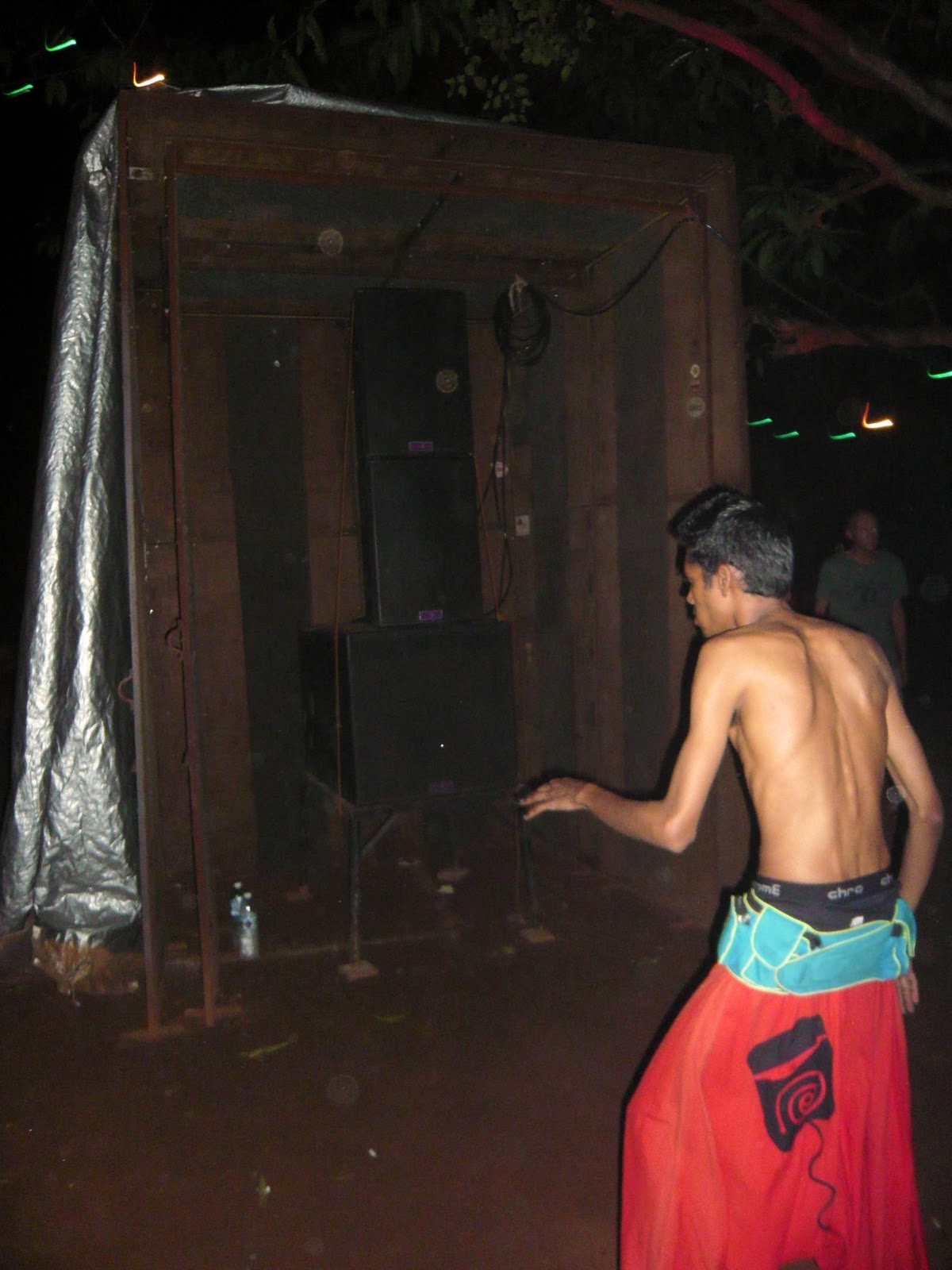
Un loco come-bafles en una discoteca al aire libre (Hilltop). A crazy subwoofer eater in a open air club (Hilltop).


Estado: Goa


En principio pensaba saltarme la casilla Goa. Goa tiene la reputación de ser un esstado alienado, llena de fiesteros de los años 60 -hippies-  y de fiesteros contemporáneos -discotequeros trance-. No me hacía falta ir a otra Ibiza. Pero después de estar unos meses en la India, la de verdad, finalmente me decidí a cogerme unas vacaciones de mis vacaciones. Me quería quedar unos 4 días y al final me quedé 2 semanas.

Como en otros viajes nocturnos, la primera impresión al levantarse el sol o al abrir los ojos suele chocar. Esta vez fue al abrir los ojos, puesto que este autobús era de lujo (como uno normal en españa, con butacas individuales y asiento reclinable) y pude dormir. Todo verde. Palmeras a izquierda y derecha. La tierra casi roja. Algo increible: señales de tráfico y rayas pintadas en la carretera. Todavía más increible: no hay apenas basura en las calles.

Goa era una colonia portuguesa. Por ello, se encuentran muchos indios con nombre y/o apellido portugués y muchos cristianos. Cuenta la leyenda que si tienes mucha suerte puedes llegar a oir en Old Goa o Panaji una conversación entre gente mayor en portugués. La capital del estado de Goa, Panaji, no tiene playa y el turista sólo va de paso o hace un día de visita. Cada playa tiene su belleza y personalidad. Anjuna es la más conocida y la más hippie históricamente. Hoy en día el turismo es masivo y poco queda del espíritu de los 60.  Después del movimiento hippie, llegaron los israelitas y sus fiestas rave. La tercera ola, que empezó hace unos años (no sé cuantos, digamos 10), se compone de engreidos turistas rusos que han elevado a Goa a un nuevo nivel de putrefacción. Recuerdo la primera vez que ví una rusa en Goa y la indignada conversación que mantuve con el vendedor que estaba a mi lado. La chica, en la parte trasera de una moto, llevaba un escueto bikini y pantalones poco más largos que la parte baja de su bañador. Choca bastante después de unos meses en India y luego no extraña a nadie que los turistas indios se queden mirando con descaro. Según entendí, Parlolem es una playa tan bonita como cara, con restaurantes y discotecas de lujo. Yo elegí Vagator beach, por estar marginada por el turismo. No era la playa más bonita pero seguro la más tranquila.
Una conversación que tuve meses más tarde en otro país:

“Wow, qué pesados son estos vendedores! Parece que estamos en Goa”, me decía un conocido.
“Yo en Goa estuve más tranquilo que en todo el resto de la India… estuve en Vagator beach, y tu?”
“Anjuna.”

Un detalle en Goa es que no hay impuestos sobre alcohol, lo que hace que una botella de ron Old Monk tenga el absurdo precio de 180 rupias (3€). No entiendo la razón, puesto que el resto de la India no invita a beber nunca alcohol y podrían sacar mucho de ello. Pero lo que no entra por un sitio entra por otro: prohibición total de fumar tabaco en sitios públicos (calles incluidas) y los policías van a multar. Por suerte la policía ignoraba Vagator tanto como los turistas.

Estuve en dos hostales. Al salir de la habitación del primero, el conocido como pink house o casa rosa, me encontraba con la playa. Fantástico, pero me moví porque el segundo era más barato. En este, la puerta daba a vegetación verde, un pequeño bosque. Y un día pude ver a mi vecino el pavo real que era demasiado tímido y se metió entre el follaje en cuanto me vió.

La comida de Goa agrega dos maravillosos ingredientes a la tradicional India: coco y pescado (o gambas, o sepia). El omnipresente thali indio evoluciona a fish thali, con pescado frito o guisado en vez de carne, y leche de coco en el curry.

Conocí en Vagator a Sahar y Lio, dos israelitas de viaje tras su servicio en el ejército y sin duda una de las razones por las que me quedé dos semanas allí. Hicimos grupo con Sid de India, Marie de Francia, Roberto de Italia y Kristof de Alemania. Vino a encontrarse con Shahar y Lio una chica israelita que casualmente había conocido antes en Kassol (Himachal Pradesh).

El primer día que hicimos escapada a una discoteca de una playa cercana (Anjuna), los camareros indios le dijeron a nuestro amigo indio Sid que no podía entrar… por ser indio. Después de una discusión nos volvimos todos a casa, una pena después de convencer a Roberto (de unos 50 años) de salir con nosotros.

Por cierto, el agua está templada incluso de noche. Genial.


State: Goa

At the beginning, I was going to skip Goa. Goa has a reputation of being an alienated state, full of party people from the 60s -hippies- and contemporary party people -trance clubbers-. I wasn't feeling like going to another Ibiza. But, after few months in India, I decided to take some holidays form my holidays. I was going for 4 days and I stayed for 2 weeks.

Just like other night trips, the first impression when you open your eyes or when the sun rises is s bit shocking. This time it was when I opened my eyes since the bus was a luxury one (like the regular ones in Spain, with individual reclining seats) so I could sleep. All is green, at left and right. The soil is almost red. Something amazing: there are traffic signs and painted lines on the road. Even more amazing: there's almost no garbage in the streets.

Goa was a portuguese colony. One can find a lot of indians with portuguese names or surnames and a lot of christians. The legens tells that if you're lucky enough, you might eavesdrop into a portuguese conversation between elder goans in Old Goa or Panaji. Panaji is the capital of the state, which has no beach and is just a passing point or one-day trip for tourists. Each beach has is own beauty and character. Anjuna is the most famous one and the historically hippy one. Nowdays turism is massive and there's little left form the 60s spirit. After the hippie movement came the israelis and their wild rave parties. The third wave, that started some years ago (no idea, let's say 10), is made out of bigheaded russian turists who brought Goa to a new level of putrefaction. I remember the first time I saw a russian in Goa and the offended conversation I had with the seller at my side. The girl, riding a bike, had a tiny bikini and shorts that were barely longer than the bottom part of the swimsuit. It's a bit shocking after few months in India and it's not surprising if indian turists stare at them shamelessly. as I understood, Parlolem is a beatiful as much as expensive beach, with luxury restaurants and clubs. I chose Vagator, for it was marginalized by tourism. It wasn't the most beautiful one but for sure one of the most quiet.

A conversation I had some months after, in another country:
"Wow, these sellers are really annoying! It's like Goa!", told me an adquaitance.
"When I was in Goa it was much calmer than in the rest of India... I was in Vagator, what about you?"
"Anjuna."

A thing about Goa is that there are no taxes on alcohol, and so a bottle of Old Monk rhum has the ridiculous price of 180 rupees (3€). I don't know why, since in the rest of India doesn't make you feel like drinking and they could have a good revenue. However, what doen't enter through one place enters fom another: it's illegal to smoke tobacco in public places (streets included) and the cops focus on those fines. Luckyly the police ignored Vagator as much as the tourists.

I've been in 2 hostels. When I come out of my room in the first one, known as Pink House, I had the sea just in front of me. I went to a second, more economical one. In this one, the room was in front of a lot of green vegetation, a little forest. One day I could see my neightbour, the peacock, who was too shy and ran away though the bushed when he saw me.

Food in goa adds to wonderful ingredients to the traditional indian one: coconut and fish (or shrimp, or squid). The omnipresent thali evolves into fish thali, with fried or stewed fish and coconut milk in the curry.

I met there sahar and Lio, two israelis travellign after their army service, and without any doubt one of the reasons I stayed there for 2 weeks. We joined others in a group: Sid from India, Marie from France, Roberto from Italy and Kristof form Germany. An israely girl friend of Shahar and Lio came to meet them and it happened that I knew her fomr Kassol (Himachal Pradesh).

The fisr day we went for a club in another beach (Anjuna), the indian waiters told out indian friend, Sid, that he couldn't enter because... he was indian. After an small argument we went back home, a shame cause we had convinced Roberto (around 50 yo) to come with us.

By the way, water is warm even at night. Great.

Barbie in India

Con su sari y con plantillas para mehendi (henna para tatuajes temporales). Visto en una tienda de Chapora (Goa). Feliz año nuevo.

With her saree and with mehendi (henna for temporal tattoos) stencils. Seen in a shop in Chapora (Goa). Happy new year.
Colchonero. Mattress-maker. (Oficios perdidos. Lost trades)
En pleno placa-placa. Going plack-plack.


En realidad no sé si estaba fabricando un colchón o aireando uno antiguo. Me inclino por el segundo. Visto en Ajmer (Rajastan).

Actually I don't know if he was making a new mattress or just airing it out. I think it was the later. Seen in Ajmer (Rajastan).

Ajanta: las cuevas. The caves. [19.11.2010]
Aquí va un gran lote de fotos.
Here goes a big load of pics.


Panorámica desde la última cueva. Panoramic view frmo the last cave.

La pintura más famosa, en la cueva 1. The most fmous painting, in cave no 1.

Buddha en posición de predicación. Buddha in preaching stance.

Otro Buddha en la misma posición. Another Buddha in the same stace.

Columnas de una cueva. Columns in a cave.

Buddha, Buddha, Buddha...

La fachada más impresionante de las cuevas. The most impressind façade of the caves.

Más pinturas. Las puertas son pequeñas celdas para los monjes. More paintings. The doors are small cells for the monks.

En gris, roca tallada. En blanco, la primera capa con pinturas hecha al principio. En oscuro, la segunda capa con pinturas, hecha 5 siglos después. In grey, carved rock. In white, the first couch of paintings, donde at the beginning. In dark, the second couch of paintings done 5 centuries later. 

Grabado. La mano es para ver su tamaño. Engraving. The hand is for seeing its size. 

En construcción: pared tallada con la figura de Buddha a medio hacer. Under construction: carved wall with the shape of Buddha.

Turistas en una cueva con stupa. Tourists in a cave with stupa.

Vista de las cuevas. View of the caves.

¿Quién es este señor? ¿Who is this man?

Tareas de conservación. No lo creo, andamio de metal con motor en vez de madera, monos de trabajo... ah, que son coreanos. Conservation tasks. I cannot believe it: overalls, scaffolding with engine instead of wood... oh, ok, they are korean.

Detalle de columna.

El Buddha. Detrás, un impostor. The Buddha. Behind, an impostor.


Estado: Maharashtra

Ajanta no tiene estación de tren, así que paré en una pequeña ciudad llamada Aurengabad. Fui al sitio más barato que aparecía en la guía: YHA hostel. 150 rupias por noche en un dormitorio. La mujer que lo llevaba tenía tanto de encantadora como de esquizoide. Tenía en su libro de cuentas una gran imagen de un Jesucristo bastante maltrecho y a su lado, una pegatina de Shiva (una muestra del cacao religioso que a veces tienen en la India). Las reglas de su hostal estaban diseñadas para atacar los nervios del huésped. Las puertas cierran a las 21h y si llegas 15 minutos tarde la señora o el guardian de noche te miran con mala cara. A las 22/23, hay que apagar las luces del dormitorio o vendrá el guardián a recordártelo. Hay que pagar 10 rupias por día por aparato electrónico que enchufes a la corriente. Si quieres dejar la mochila en el hostal el día que te marchas, porque tu bus/tren sale por la tarde, tienes que pagar 20 rupias. Y alguien, supongo que el guardían de noche, me robó la manta de Aeroflot que robé con cariño del vuelo Moscú-Delhi.

Las cuevas de Ajanta son un conjunto de 29 cuevas talladas en roca donde moraba una comunidad de monjes budistas. Se encuentran en un pequeño valle, formando una media luna que rodea un río en su parte más baja. Las primeras fueron construidas en el Siglo II AC y las últimas en el Siglo VI DC. Han sido declaradas patrimonio de la humanidad por la UNESCO en 1983. Fueron patrocinadas en su día por reyes (rajas) y personas poderosas. En el Siglo VI, con el budismo decayendo en India, por razones desconocidas las cuevas fueron abandonadas. Algunas de ellas todavía estaban en proceso de construcción. Las redescubrió un oficial inglés en 1819.
Como siempre, es una pena ir sin guía, pero no me fío ni un pelo. Un guía indio estaba buscando cliente y al verme quiso darme una muestra de su conocimiento, para que le contratara. Señaló del dedo unos grabados dónde se podían ver una figura con cara atormentada y otras dos, juntas, sonrientes.

- Mira… esto significa que el hombre no puede estar sólo. Sino, está triste. Cuando encuentra a su pareja, se completa y es feliz.
- ¿Cómo? Pero… ¿me puede explicar por qué unos monjes budistas querrían mandar ese mensaje?
Empezó a reir y se fue. Quizás tuviera razón, pero me sigo sin fiar.

El bus tardó en venir más de la cuenta y al volver al hostal tuve que suplicar otra vez que me abrieran  la puerta.


State: Maharashtra

Ajanta doesn't have a train station, so I stopped in a small city called Aurengabad. I went to the cheapest place according to the guide: YHA hostel. 150 rupees per night in a dorm. The woman managing it was as charming as psycho. She had in her accounting book a big image of a battered Jesuschrist and, at his side, a sticker of Shiva (an example of the religious confusion you have in India). The rules of the guesthouse are specifically designed to annoy the guest. The door closes at 21h, should you arrive even 15 minutes later, the woman or the night guardian pull faces to you. At 22/23h, the lights of the dorm have to be turned off, otherwise the night guardian will come to remind it to you. You have to pay 10 rupees per day for each electronic device you charge. If you want to leave your backpack the day you leave, because maybe your train/bus is going in the evening, you have to pay 20 rupees. And someone, I guess the night guardian, stole from me the Aeroflot blanket that I stole with love from the flight Moscow-Delhi.

Ajanta caves are a bundle of 29 rock-cut caves used as a dwelling by a community of budist monks. The are located in a small valley, in a shape of a halfmoon surrounding a river on the bottom part. The first ones were built on the II century BC and the last ones on the VI century AD. They've been declared World Heritage Site by UNESCO in 1983. They were patronized by kings (rajas) and rich people. In the VI century, with budism decaying in India, for unknown reasons the caves were abandoned. Some of them were still under construction. They were rediscovered by a british officer in 1819.
It's a shame to go without a guide, but I don't trust them at all. An indian guide looking for customers gave me a sample of his services. He pointed out engraved figures where you could see some person in a tormented state, and at his side, two smiling persons together.

- Look, this means that a man cannot be alone. If he does, he's sad. When he finds a wife, he's happy.
- How? Why would budist monks give this message?
He laughted and left. Maybe he was right, but I still don't trust them.

The bus came late and when I was back in the city I had to beg again so they would open the door.
Pushkar: Feria del Camello. Camel Fair. [15.11.2010-17.11.2010]

Camellos comiendo. Camels eating.


Vendedores de algodón de azúcar descansando.  Cotton candy sellers taking a break.


Saris. Sarees.

"Hazme una foto!". Claro, luego la borraré. Anda no, que ha salido bien. "Take a picture of me!". Sure, I will delete it afterwards... oh wait, it's a good one.

Sentado a lo asiático. Sitting in asian style.


"- Pero Suresh, se puede saber por qué le corta las piernas a la gente?" "- Pues porque no hay ángulo, Prakash, porque no hay ángulo." "- Suresh, why the damn is he cutting legs?" "- Because  there's no angle, Prakash, there's no angle."

Miren lo que traigo. Look what I've got.

Recogedoras de heces. Sin guantes. Supuestamente de la castas más baja de entre las bajas. Faeces collectors. No gloves. From the lowest of the lowest casts.

Caballo a punto de soltar hoces. La cara de pánico la tuvo durante toda la exhibición. Horse just before kicking. It had the same panic face for the duration of this exhibition.


Panorámica. Pierre a la derecha. Panoramic view. Pierre at right.

Estado: Rajastan

Pushkar es otra ciudad típica de la ruta turista. Es otra ciudad santa, así que nada de carne, huevos o alcohol (aunque se pueden encontrar a precios más caros si se busca).

En Pushkar se encuentra uno de los pocos templos de Brahma. Brahma es uno de los 3 dioses más importantes en el hinduismo. Es el creador inicial, el arquitecto. Es el que diseñó y estableció las reglas del universo. Pero Brahma no tiene ningún poder sobre su creación, recayendo esa responsabilidad sobre Shiva y Vishnu. Es por ello que el culto a Brahma es muy poco frecuente y los templos dedicados a él en todo el mundo se cuentan con los dedos de las manos.

Para llegar a Pushkar hay que ir en tren a Ajmer y coger un bus. Ajmer fue la primera ciudad de ninjas en la que estuve.  Entiéndase ninja por mujeres escondidas bajo batamantas negras con sólo una rendija para los ojos (burka).

La feria del camello ocupa una semana al año y llena Pushkar de turistas locales y extranjeros. Ganaderos de la región compran y venden camellos, cabras y caballos.

Un hombre mostraba los trucos que su caballo domado podía hacer. Durante unos segundos, el caballo, en medio de un círculo de gente, entró en pánico y soltó un par de coces que le rozaron la cara a un hombre. Otro shock cultural. En un pais de occidente la gente se llevaría las manos a la cabeza y retirarían al caballo o harían el círculo más amplio. Aquí todo el mundo se echó a reir.

Un par de hombres hacían tatuajes en la calle, sobre una manta. Económicos pero de diseño e higiene muy dudosos. Alguien se puso violento cuando cogí mi cámara, así que no hay foto.

Tras Pushkar, me separé en Ajmer de Aime, Jérémy y Pierre.


State: Rajastan


Pushkar is another city on the typical tourist route. It's another holy city, so no meat, eggs or alcohol (tho they are available at higher prices).

There's one of the few Brahma temples in Pushkar. Brahma is one of the 3 important gods in hinduism. He is the initial creator, the architect. The one who designed and established the laws of the universe. But Brahma has no power on his creation, this responsability goes to Shiva and Vishnu. This is the reason why Brahma cult if so infrequent and the his temples around the world could be counted on the fingers of one hand.

To arrive to Pushkar you have to take a train to Ajmer and then a bus to Pushkar. Ajmer was the first ninja city in which I've been. Understanding ninja as women hidden under black blankets with a gap for the eyes (burka).

Camel Fair is celebrated for a week and gathers loads of local and foreigner tourists. Local livestock farmers buy and sell camels, goats and horses.

A man was showing some tricks his horse could do. For an instant, the horse was panic-stricken and kicked twice grazing one man's face. Culture shock, again. In a western country everybody would freak out and the horse would be removed or the circle would be broaden. Here, everybody burst out into laughs.

A couple of men were making tatoos in the street, sitting on a blanket. cheap, but higiene and design were dodgy. Someone went edgy when I took my camera, so no pics.

After Pushkar, I split from Aimee, Pierre and Jérémy.

Udaipur [13.11.2010-15-11-2010]

Palacio del lago. Lake Palace. Source: wikipedia.org (CC License). Autor: Taj Hotels Resorts and Palaces.


Estado: Rajastan

Udaipur fue la capital del imperio Mewar y es conocida como la ciudad más romántica de  India. La Venecia de India. Tiene un gran lago y en el medio un palacio que es ahora un hotel de 5 estrellas. Muchos famosos eligen esta ciudad para casarse. De hecho corría el rumor, muy infundado, de la boda de una estrella de Bolliwood aquella noche. También es conocida porque algunas escenas de la película de James Bond Octupussy fueron filmadas allí. Hostales y bares ofrecen repeticiones de la película cada noche.

El complejo del Palacio de la ciudad es bonito pero nos decepcionó un poco. Lo de siempre: ves un palacio en el que han colgado muchos cuadros y obras de arte pero no entiendes qué es qué, cómo era la vida por aquél entonces.

Mientras hablaba con uno de mis compañeros de viaje andando por la calle, un coche pedía paso tocándo el klaxon detrás de mí. Como era de esperar, no me dí cuenta de lo que pasaba ni oí los pitidos. El conductor dió con la solución lógica al problema: acelerar. Me golpeó la pierna y caí al suelo. Tuve tiempo de levantarme, golpear una ventana y gritarle, mientras de marchaba, una de esas palabras tan bonitas en hindi que me enseñó Tarun en Delhi.

Me olvidé de la cámara cuando salimos y no pude hacer fotos, así que ahí va una fusilada.


State: Rajastan

Udaipur was the capital of the Mewar empire and is known as the most romantic city in India. The Indian Venice. It has a huge lake and in the middle a palace that is nowadays a 5 stars hotel. A lot of famous people choose this city for their wedding. There was a rumor during our stay about the wedding of a Bolliwood star, but it turned out to be that, just a rumour. It is alwaso well known because some scenes of the James Bond movie Octopussy were filmed there. Hostels and bars lay the movie everynight.

The city palace complex is beautiful, tho we were a bit disapointed. It’s like always: you enter into a plalace in which paintings and art are everywere, but still you don’t unerstand what is what, how was the life back then.

While I was chatting with a travel friend, walking up the a street, a car behind us wanted us to step aside and started to blow horn. As expected, I didn’t hear anything. The driver found the logical solution to the problem: accelerate. He hit my leg and I fell to the ground. I could stand up, hit his window and shout, while he was running away, one of those beautiful hindi words that Tarun taught me in Delhi.

I forgot my camera when we were gong out so I don’t have pictures. Here goes one from internet.
Día especial

Click para desvelar. Click to reveal.


Hoy es un día especial. Quiero dar una enhorabuena pública a una chica. Sin duda, la más hermosa que pueda haber. No hay persona más bondadosa y generosa en el mundo. Nadie puede perder la fe en el género humano cuando se conocen personas así. Es afortunado todo aquél que pueda compartir un trocito de su vida con ella.

Today is a special day. I want to congratulate publicly a girl. Without any doubt, she is the most beautiful of them all. There isn't a more kindhearted and more generous person in the world. Nobody can lose his faith in the human being when one knows such person. Those who can share a tiny part of their lives with her are fortunate.
Jodhpur [12.11.2010-13.11.2010]
Casa. House.

Subiendo al fuerte. Going up to the fort.

6 disparos de cañón en una muralla. 6 canon shots in a wall.

Vestidos para algún acto en el fuerte. Dressed up for some act inside the fort.

Vista desde el fuerte. View from the fort.

Turista india. Indian tourist.

Aimee en el fuerte. Aimee at the fort.

Panorámica desde el fuerte. Panoramic view from the fort.


Pueta de sol. Sunset.


Estado: Rajastan

La llamada ciudad del Sol, por estar este presente la mayoría del año, o ciudad azul por ser el color de las casas alrededor del fuerte. Como otras ciudades del Rajastan, tambien tiene un fuerte que corona la colina central de la ciudad. Este fuerte, Mehrangarh, es más de museo. Fue contruido entre 1459 y 1678. Está cuidado, limpio y hay que pagar entrada (aunque cuando nos dimos cuenta ya estábamos dentro). No hay habitantes, al contrario que en Jaisalmer, dentro del fuerte ni vendedores callejeros. 
Mis compañeros de viaje (Aimee, Pierre y Jérémy) entendieron mis problemas de orientación cuando fui a comprar champú y volví 3 horas más tarde justo para coger el siguiente bus. Un hombre que me vió pasar por la misma plaza dos o tres veces me llevó en moto hasta que encontramos el hostal con las pocas pistas que yo podía dar (no tenía tarjeta de visita del hostal ni teléfono). No me dejó invitarle a nada de beber o comer.


State: Rajastan

The so called city of the sun, for it's sunny almost all year around,or blue city, because of the colour of the houses surrounding the fort. Like in others cities in Rajastan, there's a fort crowning the hill in the middle of the city. This fort, Mehrangarh, is more like a museum. It was constructed between 1459 and 1678. It's maintained, clean and there's an entrance fee (that we realised when we were already inside). There are no people living inside the fort nor street sellers, unlike Jaisalmer.
My travel friends (Aimee, Pierre and Jérémy) understood my orientation problems when I went to buy shampoo and I came back 3 hours later, just in time for the next bus we would take. A man who saw me passing throught the same square twice or trice took me in his bike until we found the hostel with the few clues I could give (no hostel business card, no mobile phone). He didn't let me buy him any drink or food.